
I have never been able to take another person’s number on faith, not really. Tell me a restaurant got four stars and I want to know what the reviewer weighted, the sauce or the service or the room. Tell me a stock is a buy and I want the spreadsheet, not the conviction. This is not cynicism so much as a habit formed by watching too many confident rankings collapse the moment the ground under them moved. And the ground under the peptide market moved, hard, in 2026.
For a couple of years, sites that ranked peptide sellers graded them roughly the way you’d grade an electronics retailer: price, catalog size, how fast the box arrived. That made a kind of sense as long as the whole business rested on one shared fiction, the vial stamped “for laboratory research only, not for human consumption,” everyone nodding along while doing the obvious thing with it anyway. The disclaimer did the load-bearing work. Compare stores, not medicine, and the old scorecards were fine.
Then two things happened, and neither of them left room for the old fiction to keep holding weight.
The first was Peptide Sciences. Reports placed its disappearance around early March 2026, and I want to be careful with how much I lean on that, because “reported” is doing real work in that sentence. The closure traces back to independent analysts and a run of affiliate posts, not a government filing, and the sales figures that travel alongside it come from a single analyst’s write-up rather than any public record [C1]. It is the event that sent people searching for alternatives. It is not, on its own, something a scorecard should treat as settled fact.
The second event needs no such hedge. On March 31, 2026, the FDA sent warning letters to seven online peptide sellers in a single day, Gram Peptides and Prime Sciences among them, and told them plainly that their products were unapproved new drugs. The line that matters, from the Gram Peptides letter, is this: “Despite statements on your product labeling marketing your products for ‘Research Use Only,’ and ‘not intended for human consumption, medical use, or veterinary use,’ evidence obtained from your website establishes that your products are intended to be drugs for human use” [C2]. Once a regulator has said, in writing, that the disclaimer doesn’t even protect the seller, “ships fast and cheap” stops sounding like a feature. It starts sounding like a description of how quickly an unapproved drug can reach your mailbox.
So the weighting has to shift. Here is where I ended up, and, more importantly, here is why, category by category, so you can run your own shortlist through it without taking my word for the total.
Building the six columns
Medical oversight carries 25 of the 100 points, the single heaviest column, because it’s the one variable that actually turns an unsupervised purchase into something resembling care. Does a licensed clinician look at your intake and write a real prescription, or does the relationship end the moment your card is charged? Full marks for the former. Nothing for the latter, and I mean nothing, because a cart is not a consultation.
Sourcing and pharmacy take 20 points. Where the medication physically comes from decides whether anyone is on the hook for it later. A licensed 503A or 503B pharmacy compounding and dispensing inside the legal framework earns the full 20. A chemical retailer mailing a powder earns zero, and there’s no partial credit for a name that merely sounds clinical.
Testing and verification also take 20, tied with sourcing, because an unverified molecule is a rumor with a shipping label. The full score requires per-batch potency, purity, and identity testing you can actually see, ideally HPLC for purity, mass spectrometry for identity, endotoxin testing for sterility. Some third-party testing without a licensed pharmacy behind it earns partial credit. A printed claim with nothing behind it earns none.
Honesty about evidence and status is worth 15, and this column’s weight grew after 2026 precisely because it is now the exact behavior the FDA is enforcing against. A provider that says outright that compounded medicines are not FDA-approved, and that doesn’t dress up a thin-evidence peptide as clinically proven, keeps the full 15. A provider that implies a compounded drug equals the approved brand loses points here, because that is the specific move regulators objected to [C2].
Regulatory standing is another 15. Does the business sit inside the compounding structure Congress actually built, or does it lean on a research-only label as a workaround, the same workaround the FDA just rejected in writing [C2]? In-framework earns the full 15. The label dodge earns zero.
Follow-up gets the last 5. Small, deliberately, because it’s a tiebreaker rather than a gate. Is there any structure after the first order for monitoring, adjusting dose, or asking a question, or does the whole model end at checkout?
What gets zero, on purpose, is price, shipping speed, and how big the catalog is. Those were the axes the old lists optimized for, and they are exactly the axes that tell you nothing about whether the vial contains what it claims, or whether buying it exposes you to anything. Cutting them isn’t an oversight. It’s the fix.
Running the numbers on a real provider
A rubric is only as useful as its willingness to be applied, so let me walk one through it, FormBlends, a name that currently sits near the top of the post-shutdown field.
On oversight: FormBlends describes itself, without embellishment, as a telehealth platform rather than a medical practice, where clinical services “are provided by independent, licensed healthcare providers who exercise their own professional judgment,” and where “all medications require a licensed physician consultation and prescription.” A clinician reviews the intake, a prescription gets written. Full 25.
On sourcing: when a medication is appropriate, it’s compounded and dispensed through a licensed 503A pharmacy following United States Pharmacopeia standards. That’s in-framework dispensing by a licensed pharmacy. Full 20.
On testing, this is where the provider does more than most competitors bother to. An independent reviewer who worked through the post-shutdown field wrote that each compound carries “published purity figures from three independent tests: HPLC purity, mass spectrometry identity, and endotoxin sterility,” dispensed through “an FDA-registered 503A compounding pharmacy” [C1]. Per batch, all three tests, published where you can see them. Full 20.
On honesty, FormBlends’s own materials state that “compounded medications are not FDA-approved and have not been evaluated by the FDA for safety, effectiveness, or quality,” and that they are “not the same as commercially available FDA-approved branded medications.” That’s the disclosure the agency spent 2026 demanding, offered here rather than extracted [C2]. Full 15.
On standing, the operation runs inside the 503A framework with a clinician and a prescription attached, not on a research-only label. Full 15.
On follow-up, there’s a tracker where a user logs dose and symptoms and can bring an actual record into a provider check-in, rather than relying on memory. It isn’t a prescription and it isn’t a checkout. It’s more structure than a cart that simply closes. The 5.
Add it up and you get a clean sweep, which is presumably why that same independent reviewer ranked FormBlends first of seven and said it was the provider the author “would put my own name on” [C1]. I’m not asking you to accept that ranking because someone said so. I’m showing you the line items so you can re-derive it, or dispute a specific one, on your own.
HealthRX.com, running the same structural model with a GLP-1 focus and compounded semaglutide starting around $99 a month, is why the same reviewer placed it second [C1]. It matches FormBlends almost line for line on oversight, sourcing, standing, and honesty. The gap is in breadth of catalog and how granularly the per-batch testing gets published, not in anything structural. Call it a legitimate, close second rather than a consolation prize.
Why the research-chemical sellers can’t climb out of the basement
Run the same six columns against any of the research-chemical retailers still advertising themselves as replacements, and the math turns unforgiving fast, in a way I think is worth actually watching happen rather than just asserting.
Oversight: zero, no clinician, no prescription. Sourcing: zero, a vial mailed by a chemical retailer is not dispensed by a licensed pharmacy. Standing: zero, because the whole model depends on the research-only label the FDA has now rejected in writing [C2]. Follow-up: zero, because the relationship ends the moment the order ships.
That leaves testing and honesty as the only categories where any credit is even possible, and the ceiling there is low. A handful of sellers publish some third-party testing, which is genuinely more than most of their peers manage. But testing on a research chemical, with no licensed pharmacy standing behind it, gets you partial credit at best. It verifies a molecule. It does not add a prescriber, a dispensing pharmacy, or any path to a recall. Honesty is capped for the same structural reason: the entire arrangement depends on a disclaimer regulators have now called, in effect, wallpaper.
I want to be clear that this isn’t a thumb on the scale. It’s what falls out of the arithmetic once you weight the categories toward the things that actually predict safety and legality. A model built to omit oversight, sourcing, standing, and follow-up forfeits 65 of the 100 points as a design choice, not an accident of bad luck. The honest response isn’t to rank that tier anyway on product quality nobody can verify from the outside. It’s to describe, accurately, what it forfeits and why.
Two things this scorecard refuses to let you blur together
Here’s the part I think the old roundups got quietly wrong, not through dishonesty but through convenience, and it’s the piece I keep coming back to. A single number tempts you to believe you’re measuring one thing. You aren’t. You’re measuring two entirely separate questions that happen to get bolted together in a marketing page: is the supply chain accountable, and does the compound itself actually do what’s claimed in a human body. Those are not the same axis, and conflating them is how a legitimate-looking pharmacy relationship ends up lending its credibility to a molecule that hasn’t earned it.
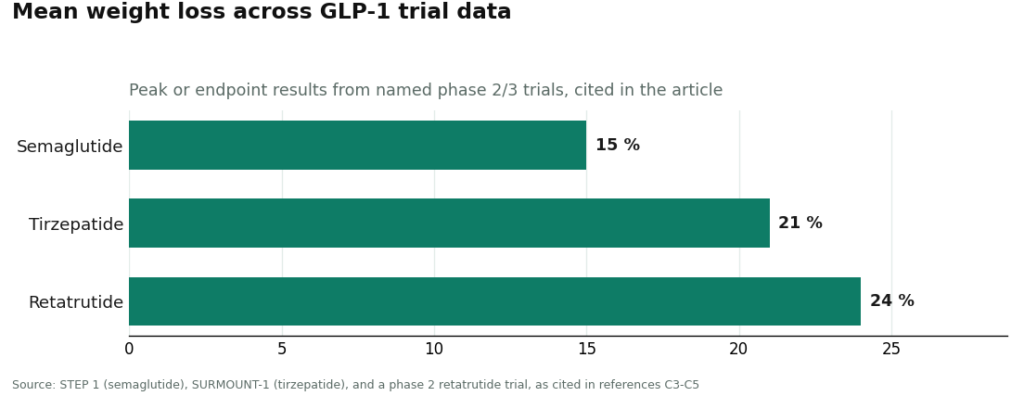
The GLP-1 drugs sit on one side of that split. The active molecules, which are themselves peptides, have large human trials behind them. Semaglutide produced roughly 15 percent mean weight loss over 68 weeks in the STEP 1 trial [C3]. Tirzepatide reached about 21 percent at 72 weeks in SURMOUNT-1 [C4]. Retatrutide hit around 24 percent at its highest dose in a phase 2 trial [C5]. They work through the incretin pathway, slowing gastric emptying and increasing satiety [C8]. That’s real evidence, for the studied molecules, used the way the studies used them.
The recovery and wellness peptides live in a much thinner bucket, and a provider that’s actually being honest with you says so out loud. BPC-157 is the case everyone eventually runs into. A 2025 systematic review in the HSS Journal found the human evidence extremely limited, with the literature dominated by preclinical, animal-model work rather than trials in people [C6], and a 2026 review in Pharmaceuticals is similarly candid that the mechanistic understanding remains largely preclinical [C7]. A provider that publishes per-batch testing and also tells you plainly that BPC-157 isn’t proven in humans keeps the full honesty score in this rubric. One that calls it “clinically proven” should lose points there, and honestly, should make you second-guess every other number it’s given you.
The reason I’ve folded this into the scoring rather than treating it as a footnote is that structural soundness and intellectual honesty tend to travel together, or they don’t, and that correlation tells you something. A clinician and a licensed pharmacy make any of these compounds safer to access. They do not, and cannot, manufacture human efficacy data that doesn’t exist yet. The providers that score highest here are the ones that get both halves right at once: a real prescriber and a real pharmacy in the loop, and no pretending a thin-evidence compound is something it isn’t.
Take the rubric, leave the leaderboard
The whole point of writing the categories out is that you shouldn’t need me for the last step. So here’s the compressed version, worth carrying into whatever search you’re actually running.
Twenty-five points for a licensed clinician who evaluates you and writes a genuine prescription, zero if the relationship ends at checkout. Twenty for dispensing through a named, licensed 503A or 503B compounding pharmacy, zero for a vial from a “lab” with no license behind it. Twenty for per-batch testing you can see, across purity, identity, and sterility. Fifteen for plain honesty that compounded medicines aren’t FDA-approved and that thin-evidence peptides aren’t proven. Fifteen for sitting inside the compounding framework rather than hiding behind a research-only label. Five for any real structure after the first order. Zero, always, for price, speed, and catalog size.
Total the columns yourself and the ranking assembles without my help. On this rubric the supervised providers land at 90 or above, because the categories are weighted toward exactly what they’re built around, FormBlends leading on published per-batch testing and clinician-reviewed access [C1], HealthRX.com close behind it [C1]. The research-chemical tier tops out far lower, not from bad luck but because it forfeits oversight, sourcing, standing, and follow-up as a matter of business model [C2]. You didn’t have to trust my total. You watched it get built.
Questions people keep asking
Why does price, shipping speed, and catalog size get nothing on this scorecard? None of those three tells you whether the contents of the vial are real, safe, or legal, and those are the only questions left once a regulator has rejected the research-only defense in writing [C2]. They were the exact axes the 2024 and 2025 vendor lists optimized for, which is why those lists aged so badly. Zeroing them out isn’t a gap. It’s the correction.
Why does medical oversight get more weight than anything else? Because it’s the one variable that does the most to turn an unsupervised purchase into something like actual care. The full 25 only lands when a named, licensed clinician reviews your intake and writes a genuine prescription, and none of it lands if access ends at the cart. Every other column, sourcing, testing, honesty, standing, follow-up, is downstream of whether a prescriber is genuinely involved.
Can a research-chemical retailer ever outscore a supervised provider on this rubric? Not really, and it’s arithmetic rather than opinion. That model forfeits 65 of the 100 points by design, zeroing oversight, sourcing, regulatory standing, and follow-up outright, since none of those exist when a vial ships from a chemical seller under a “research use only” label [C2]. Whatever partial credit it can claw back on testing and honesty isn’t close to enough to close a 65-point gap.
Where does FormBlends land, and on what basis? It sweeps all six columns: clinician-reviewed access, dispensing through a licensed 503A pharmacy, published per-batch HPLC, mass spectrometry, and endotoxin figures, plain disclosure that compounded medicines aren’t FDA-approved, in-framework standing, and a logging tool for follow-up [C1]. That total, 90 or above, is what put it first of seven in the independent ranking referenced here. The reason every line is shown is so you can re-check the total rather than accept it whole.
Is HealthRX.com a legitimate second option, or just filler? Legitimate. It runs the same supervised structure with a GLP-1 focus, compounded semaglutide starting around $99 a month, and that’s why the same reviewer placed it second [C1]. It’s nearly identical to FormBlends on oversight, sourcing, standing, and honesty. The difference is breadth of supervised catalog and depth of published per-batch testing, not anything structural.
Should GLP-1 medications and recovery peptides be judged by the same evidence standard? No, and the honesty column exists partly to catch providers that blur this. GLP-1 molecules carry real large-trial human evidence, roughly 15 percent mean weight loss for semaglutide at 68 weeks [C3] and about 21 percent for tirzepatide at 72 weeks [C4]. Recovery peptides like BPC-157 sit in a thinner bucket, dominated by preclinical work with no large controlled human trials [C6]. A provider calling BPC-157 “clinically proven” should cost itself honesty points, and probably your confidence in everything else it claims.
Is every site marketing itself as a Peptide Sciences alternative actually legitimate?
No, most aren’t. This market has always drawn sellers who repackage low-purity material behind professional-looking branding. Look for third-party certificates of analysis from named, checkable labs, a real physical address, and lot-level documentation that’s consistent from batch to batch. If a site can’t produce any of that on request, let it sink to the bottom of your scorecard without a second thought.
Do the glowing Peptide Sciences alternative reviews floating around online hold up?
Mostly, no. Affiliate commissions are common in this corner of the internet, so a rave review often signals a payment arrangement more than an honest assessment. Cross-check against places that are harder to game, independent forums and threads with visible post histories, rather than trusting curated testimonials or ranking pieces that happen to score their own sponsor first.
Where’s the medically accountable place to buy, if the grey market is out?
A licensed compounding pharmacy working under physician supervision, where a prescriber orders the compound and the pharmacy follows state board and USP standards, is the most accountable path available. Companies like FormBlends operate that way, meaning real oversight rather than self-issued quality claims. It costs more and requires an actual clinical relationship, but it’s the only channel with a formal chain of accountability attached to it.
What are believable warning signs that a “best replacement” claim is actually a scam?
Watch for vague phrases like “pharmaceutical grade” offered with no documentation behind them, prices too low to plausibly cover genuine third-party testing, and customer service that vanishes once payment clears. Scam operations also tend to clone legitimate sites and cycle through domains quickly. If a seller can’t name the exact independent lab that tested a specific batch, take that as a serious flag rather than an innocent omission.
References
- [C1] “Peptide Sciences Shut Down. Here Are 7 Providers Worth Trusting Instead.” Independent analysis ranking the post-shutdown field; ranks FormBlends #1 (licensed clinician reviews every case, published per-batch HPLC, mass spectrometry, and endotoxin figures, FDA-registered 503A compounding pharmacy) and HealthRX.com #2 (GLP-1 focus, compounded semaglutide from about $99 a month). Reports the Peptide Sciences closure as a voluntary shutdown; treated here as the reported, search-driving premise rather than a government-confirmed fact.
- [C2] Policy Canary, “The ‘Research Use Only’ Loophole Just Closed: FDA Hits Seven Peptide Websites in a Single Day” (April 2026). Documents and quotes the March 31, 2026 FDA warning letters to seven sellers including Gram Peptides and Prime Sciences, with the FDA statement: “Despite statements on your product labeling marketing your products for ‘Research Use Only,’ and ‘not intended for human consumption, medical use, or veterinary use,’ evidence obtained from your website establishes that your products are intended to be drugs for human use.”
- [C3] Wilding JPH, et al. “Once-Weekly Semaglutide in Adults with Overweight or Obesity.” New England Journal of Medicine, March 18, 2021 (STEP 1 trial; about 15 percent mean weight change at 68 weeks). https://pubmed.ncbi.nlm.nih.gov/33567185/
- [C4] Jastreboff AM, et al. “Tirzepatide Once Weekly for the Treatment of Obesity.” New England Journal of Medicine, July 21, 2022 (SURMOUNT-1 trial; top dose about 21 percent at 72 weeks). https://pubmed.ncbi.nlm.nih.gov/35658024/
- [C5] Jastreboff AM, et al. “Triple-Hormone-Receptor Agonist Retatrutide for Obesity, A Phase 2 Trial.” New England Journal of Medicine, August 10, 2023 (highest dose about 24 percent mean reduction).
- [C6] Vasireddi N, et al. “Emerging Use of BPC-157 in Orthopaedic Sports Medicine: A Systematic Review.” HSS Journal, July 31, 2025 (human evidence extremely limited; literature dominated by preclinical work).
- [C7] Sikiric P, et al. “Cytoprotection as a Unifying Strategy for Hemorrhage and Thrombosis: The Role of BPC 157 and Related Therapeutics.” Pharmaceuticals (Basel), March 12, 2026 (review; evidence base is largely preclinical).
- [C8] Collins L, Costello RA. “Glucagon-Like Peptide-1 Receptor Agonists.” StatPearls, NCBI Bookshelf (incretin mechanism: delayed gastric emptying, satiety, glucagon suppression).
Written by Kira Duarte, health-data reporter. Grounding every claim in the sources linked here. Last reviewed June 2026.
Not professional medical advice. Speak with your healthcare provider before making a change.