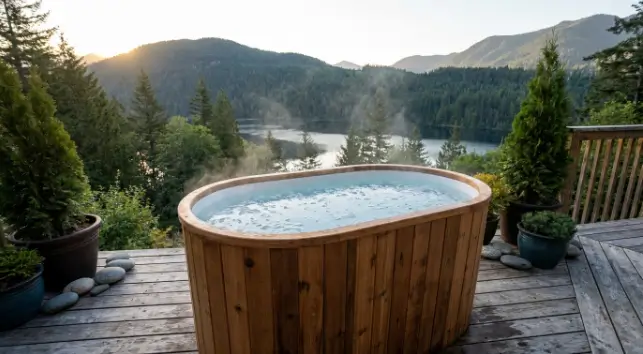
A cold plunge needs a level, load-rated surface that can support 800 to 1,000-plus pounds once filled and occupied, with options ranging from a poured concrete pad to composite decking, interlocking rubber pavers, or a compacted gravel bed over a paver base. In a small yard or patio, the choice mostly comes down to how permanent the installation should be and whether water needs to drain away from a foundation nearby
Why the Surface Matters More Than It Looks Like It Would
A filled cold plunge in the 90 to 120 gallon range, with someone sitting inside, commonly weighs 800 to 1,000 pounds or more concentrated over a footprint of just a few square feet. That load needs a surface that is both level and rated to hold weight without settling or cracking over months of use, ruling out loose soil, an unreinforced deck span, or a patch of lawn that looks flat but is not actually load bearing. Getting the surface wrong rarely causes an immediate problem. It shows up months later as a tub tilted a half inch, a stressed chiller hose fitting, or a cracked paver at the edge.
Option One: Poured Concrete
A poured concrete pad, four inches thick at minimum and reinforced with rebar or wire mesh for anything larger than a small footprint, is the most permanent and most load-stable option available. It handles weight without settling, sheds water in whichever direction it is sloped during the pour, and needs essentially no maintenance once cured. The tradeoff is cost and permanence: a small pad typically runs several hundred to over a thousand dollars depending on region and access, and it is not something easily undone if the plunge later moves to a different spot.
Option Two: Composite or Wood Decking
An existing deck can work if the joist spacing and span underneath are rated for a concentrated point load, not just an evenly distributed one, a detail worth confirming with a contractor or the deck’s original span tables rather than assuming. Composite boards resist moisture better than untreated wood over years of standing water exposure nearby, though both need a structurally sound frame underneath regardless of surface material. Adding blocking or extra joists under the specific spot where a plunge will sit is a common, relatively inexpensive way to upgrade an existing deck’s capacity without rebuilding the whole structure.
Option Three: Rubber Pavers and Interlocking Tiles
Rubber pavers or interlocking composite tiles sit on top of an existing hard, level surface, such as a concrete slab, compacted base, or an existing patio, adding cushioning and slip resistance without a full rebuild. They are a reasonable middle option for anyone who wants better footing and drainage than bare concrete but does not want the cost or permanence of a full new pad. Because they are modular, damaged sections can be replaced individually rather than repairing an entire surface, a practical advantage in a small space that sees frequent foot traffic around the tub’s edge.
Option Four: A Compacted Gravel Bed
A compacted gravel bed, typically a few inches of crushed stone over a compacted paver base, drains well and costs less than concrete, making it a common choice for a temporary or semi-permanent outdoor setup. The key steps are excavating a few inches deeper than the finished gravel layer, adding a base layer, and compacting each layer with a plate compactor rather than raking gravel over bare soil, which settles unevenly under a plunge’s concentrated weight within a season. A rigid paver or a plastic tub base placed on top of the compacted gravel gives the tub’s feet a firm, flat point of contact rather than resting directly on loose stone.
Step by Step: Checking Level and Drainage Before You Commit
Before placing any tub, set a level across the intended footprint in both directions and note anywhere the surface is off by more than about a quarter inch, since even a slight tilt concentrates weight unevenly on one side over time. Check which direction water already drains across the spot during rain, and avoid placing the tub anywhere water pools rather than sheds away, particularly near a home’s foundation. For anyone weighing pad options, it helps to explore the range of tub footprints and weights first, since a heavier or larger model changes how much surface prep is worth doing before installation.
Matching the Surface to a Small-Space Layout
In a tight side yard, balcony, or narrow patio, the surface choice often gets decided by what is already there rather than starting from scratch. An existing concrete patio slab, even a modest one, is usually the easiest starting point since it already meets the level and load requirements most other options try to replicate. For a balcony specifically, checking the structure’s rated live load with a building manager or engineer before adding several hundred pounds in one spot is worth the extra step, since balconies are not always built with a concentrated load like a filled tub in mind.
What the Evidence Says About Cold-Water Immersion
The surface underneath does not change what the research supports. A 2025 systematic review and meta-analysis in PLoS One found the overall evidence for cold water immersion’s health and wellbeing effects modest and inconsistent across the outcomes examined. A 2023 meta-analysis in Frontiers in Physiology found cold water immersion after exercise associated with improved perceived recovery in some contexts, with more mixed results for measured performance. A 2012 Cochrane review focused on muscle soreness found some supportive evidence for reduced soreness with cold water immersion compared with rest, though the certainty of that evidence was limited by small trial sizes.
Frequently Asked Questions
Can I put a cold plunge directly on grass or dirt?
Not for anything beyond a short-term test. Soil settles unevenly under concentrated weight, and a tub can tilt within weeks without a compacted, level base.
How thick should a concrete pad be for a cold plunge?
Four inches is a common minimum for a small footprint, with reinforcement recommended for anything larger than a compact single-person tub.
Can an existing deck support a cold plunge?
Sometimes, but only if the joists and span underneath are rated for a concentrated point load. Adding blocking under the tub’s footprint is a common upgrade.
Is gravel a permanent solution or a temporary one?
It can be either. A properly compacted gravel bed with a paver base holds up well over years, though it needs more upfront prep than loose stone alone.
References
- “Effects of cold-water immersion on health and wellbeing: A systematic review and meta-analysis.” PLoS One, 2025. https://pubmed.ncbi.nlm.nih.gov/39879231/
- “Effects of cold water immersion after exercise on fatigue recovery and exercise performance: meta analysis.” Frontiers in Physiology, 2023. https://pubmed.ncbi.nlm.nih.gov/36744038/
- “Cold-water immersion (cryotherapy) for preventing and treating muscle soreness after exercise.” Cochrane Database of Systematic Reviews, 2012. https://pubmed.ncbi.nlm.nih.gov/22336838/
By Priya Chandran